



How Content Marketing Impacts Your SEO Rankings
There’s no arguing that search has changed. A lot. Content still drives SEO rankings, but rankings aren’t telling us the full story anymore. Google surfaces answers directly on the results page. AI-generated summaries influence what people click, what they trust, and what they never bother to leave the SERP to find.
That means content marketing and SEO now operate as one system. Your content creates the signals search engines use to evaluate expertise, match intent, and decide whether to show your brand in the answer layer. Your SEO work makes sure that content loads fast, reads clearly, and earns the visibility it deserves.
If your content strategy still treats SEO like a checklist, you will plateau. If you treat content as the engine behind search visibility, authority, and conversion intent, you will build momentum that compounds.
Quick Takeaways
- Content marketing SEO works best when you build topical authority, not isolated blog posts.
- Search visibility now includes rankings, featured snippets, rich results, and AI answer placement.
- E-E-A-T has real operational implications: credible authorship, sourcing, clarity, and experience-based examples.
- Answer Engine Optimization (AEO) helps your content show up in the answer layer, not just the blue links.
- Measure impact beyond traffic using visibility, assisted conversions, and lead quality signals.
Why SEO and Content Marketing Are No Longer Separate
A decade ago, teams treated content marketing as the “creative” side and SEO as the “technical” side. That split does not hold up anymore.

Search engines rely on content to understand:
- what your brand covers
- whether you answer real questions clearly
- whether other sites cite you
- whether users trust your page enough to stay, scroll, and take action
At the same time, SEO determines whether your content can compete:
- pages must load fast
- search engines must crawl and index the right versions
- metadata must match intent
- structure must support skimming, comprehension, and extraction
You can publish excellent content and still underperform if you ignore SEO fundamentals. You can optimize every technical detail and still underperform if your content lacks originality, clarity, and authority. In 2026, you win when both sides work together as one system.
How Search Has Changed: Intent, AI, and Zero-Click Results
For years, the goal of SEO felt simple: rank high, get the click, win the traffic.
Now the SERP often answers the question before anyone clicks.
Between featured snippets, knowledge panels, “People also ask,” video carousels, local packs, and AI-generated summaries, Google and other search platforms increasingly keep users in the results experience.
This creates two practical shifts for content marketing SEO:
First, you must optimize for visibility, not only clicks.
If your content fuels a snippet, a “People also ask” answer, or an AI summary, your brand can still win attention even when traffic does not spike.
Second, you must match intent with more precision.
Google does not reward pages that repeat general definitions. It rewards pages that answer specific questions, show proof, and help a user complete a task.
This is why “content marketing impacts SEO rankings” no longer means “publish more blog posts.” It means:
- cover a topic deeply
- structure answers clearly
- support claims with sources and experience
- connect content into a system that signals authority
Building Topical Authority in 2026
Most brands still approach SEO like a library of unrelated articles. That approach makes it hard to rank consistently because it fails to prove authority.

Topical authority means your site demonstrates full coverage of a subject area. It tells search engines, “We do not publish one-off opinions. We provide a complete body of useful knowledge.”
To build topical authority, treat your content like a hub, not a pile.
Organize content into clear themes
Group content into categories that reflect how buyers actually search. Keep the labels practical. Avoid internal jargon.
Then build supporting pages around each theme:
- foundational guides
- comparisons and alternatives
- “how to” workflows
- common mistakes
- templates and checklists
- definitions and FAQs
Build internal links with intent
Internal links do more than move traffic. They show structure. They help search engines understand relationships between topics.
Link from broad guides to narrower supporting posts. Link back up to the hub. Use anchor text that describes the destination clearly.
Cover the full query set, not just the head term
A single keyword does not represent a topic anymore. Each topic contains dozens of queries across multiple intent types:
- learn: “what is…”
- compare: “X vs Y”
- choose: “best…”
- solve: “how to fix…”
- validate: “is X worth it”
When you cover the topic fully, your rankings stabilize because you do not rely on one page to carry the entire strategy.
Creating E-E-A-T Content That Ranks
Google’s quality frameworks reward content that demonstrates experience, expertise, authoritativeness, and trustworthiness.
In 2026, E-E-A-T is a practical standard that influences whether your page earns visibility in competitive searches and whether an AI system considers your content citation-worthy.

Experience: show firsthand insight
Experience means your content reflects real work, real outcomes, and real constraints.
Add experience by including:
- specific examples from projects
- lessons learned
- decision criteria
- tradeoffs and what to watch for
Avoid writing like a glossary. Write like someone who has done the work.
Expertise: make the complex easy to apply
Expertise shows up in clarity. If your page uses vague language, it reads like a rewrite of other blog posts. Search engines see that too.
Teach the concept in simple language. Give the reader a clear next step.
Authoritativeness: earn citations and mentions
Authority builds when credible sites cite your work and when your brand becomes a reference point.
That happens when you publish:
- original frameworks
- strong points of view
- research and data
- unique examples others can quote
Trustworthiness: support claims and reduce ambiguity
Trust grows when you:
- cite reputable sources when you reference stats or standards
- keep content updated
- avoid exaggeration
- make it easy to contact your organization
- present information transparently
If your content touches on sensitive areas such as health, finance, or legal risk, raise the bar even higher. Search engines scrutinize those topics heavily because incorrect guidance can cause harm.
Optimizing for Answer Engines (AEO)
Answer Engine Optimization (AEO) focuses on making your content easy to extract, easy to trust, and easy to use in answer formats.

This matters because the answer layer now influences what users believe before they click anything.
AEO does not replace SEO. It strengthens it.
Use question-based headings
If users search questions, your headings should mirror them.
Examples:
- What is content marketing SEO?
- How does content marketing improve SEO rankings?
- What content formats perform best in AI search results?
Put the answer first, then expand
After each question-based heading, give a direct answer in a short paragraph. Aim for clarity over cleverness.
Then expand with:
- steps
- examples
- use cases
- common mistakes
Use structured formatting
Answer engines extract content more reliably when your page includes:
- short paragraphs
- numbered steps for processes
- simple tables for comparisons
- bulleted lists when the user needs scanning
Add schema where it fits
Schema does not guarantee results, but it increases eligibility for rich features.
Common options:
- FAQ schema for question-driven sections
- HowTo schema for step-based instructions
- Article schema for standard posts
- Organization schema to support brand legitimacy
Make your content citation-worthy
AI systems tend to reward sources that:
- explain concepts clearly
- support claims
- show expertise
- avoid fluff
If your content reads like every other page on the internet, it is harder to elevate. If your content includes a crisp definition, a practical framework, and a clear example, it becomes easier to cite.
Technical Foundations That Still Matter
Technical SEO will never replace good content. But technical issues can block good content from ranking.
You do not need an enterprise audit to address the basics. You need consistent hygiene.
Design for real users
Make content easy to read:
- clear headings
- scannable sections
- readable font sizing
- sensible spacing
- strong mobile usability
When users bounce quickly, it sends a signal that your page did not satisfy intent.
Improve page speed
Speed impacts user experience and crawl efficiency. Check performance regularly and fix common issues:
- oversized images
- heavy scripts
- poor caching
- slow hosting
Keep URLs clean and readable
Use short, descriptive URLs that reflect the topic. Avoid random strings or unnecessary folders.
Prevent duplicate content problems
Duplicate pages can confuse indexing and split authority. Use:
- canonical tags when needed
- redirects when consolidating
- consistent internal linking to the preferred URL
Optimize images for search and accessibility
Images affect SEO in two ways: page performance and relevance.
Use:
- compressed files
- descriptive filenames
- alt text that explains the image clearly
- captions when useful for context
Alt text should describe the image. It should not read like a keyword dump.
Measuring SEO Impact Beyond Traffic
Traffic still matters, but it is no longer the only signal of success.
When search platforms answer questions directly, your content can influence buyers without generating a click. That is frustrating if you only track sessions. It is powerful if you track visibility and outcomes.
Metrics that matter in 2026
Track a mix of:
- organic visibility for priority topics
- rankings plus SERP feature coverage (snippets, PAA, video results)
- branded search growth
- assisted conversions influenced by organic content
- lead quality and pipeline contribution
- engagement signals that indicate intent match (time on page, scroll depth, next-page actions)
Tools that help you measure
Use:
- Google Search Console for queries, impressions, click-through rate, indexing, and page performance
- GA4 for engagement and conversion paths
- an SEO platform (Ahrefs, Semrush, similar) for competitive gaps and SERP features
- a simple dashboard that ties content to outcomes, not only sessions
The real goal is decision-making. Measurement should tell you:
- what content earns visibility
- what content drives qualified actions
- what content needs a refresh, consolidation, or rewrite
Content Refresh and Pruning Strategy
Refreshing content remains one of the highest ROI moves in content marketing SEO. Search engines reward relevance. Readers reward clarity.
Content updates also help you avoid the slow decay that happens when competitors publish newer, better answers.
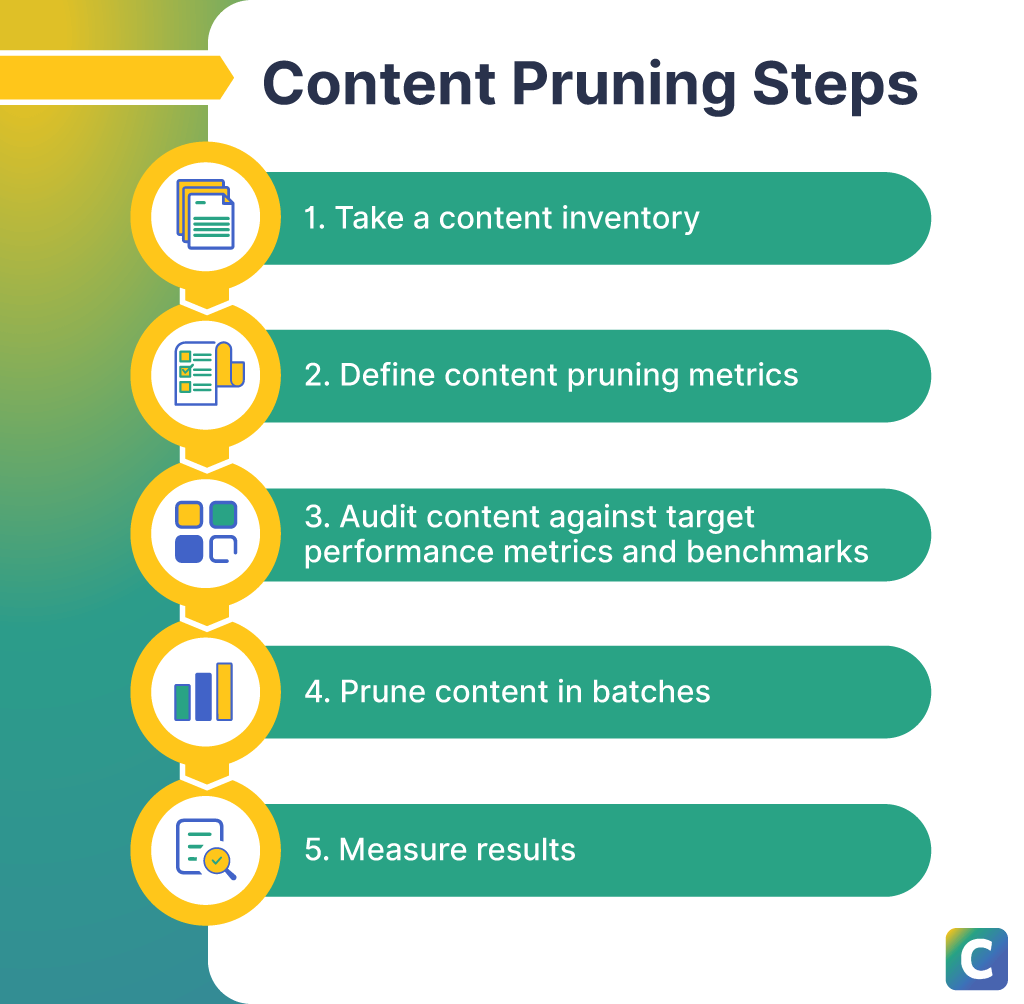
Refresh, consolidate, or prune
Not every old post deserves an update.
Use three actions:
- Refresh: update examples, improve clarity, add missing sections, and align to intent
- Consolidate: merge overlapping posts into one stronger page and redirect the weaker URLs
- Prune: remove content that no longer aligns to your brand or provides value
What to update first
Prioritize pages that:
- already earn impressions but have low click-through rate
- rank on page two and can break into page one
- cover topics you want to own
- include outdated stats, tools, or references
- show declining performance over time
A good content refresh improves rankings, but it also improves conversion intent because it better matches what the reader actually needs.
Strategic Syndication and Distribution
Even strong content can fail if nobody sees it.
Distribution amplifies SEO in three ways:
- it drives early engagement
- it increases the chance of earning links and mentions
- it expands branded search awareness over time
Build real connections
Earn links by contributing value:
- collaborate with industry experts
- publish co-created research
- offer data others can cite
- pitch thought leadership that adds something new
Use social promotion as amplification
Social does not need to be a ranking factor to matter. It accelerates reach. It puts content in front of people who may later cite it, link to it, or search for your brand directly.
Use syndicated and licensed content strategically
Syndication can support authority when handled correctly. Manage canonicalization and publishing agreements so search engines understand where the original source lives.
Licensed content can also help fill topic gaps when budgets limit original production, but you still need original perspectives and unique pages that differentiate your brand.
The Future: Visibility in an AI Search Era
SEO will keep evolving, but the direction stays consistent.
Search platforms reward content that:
- answers questions clearly
- demonstrates experience and expertise
- earns trust through accuracy and transparency
- helps users complete a task
- supports extraction into snippets and AI answers
If your content marketing strategy builds topical authority, strengthens E-E-A-T, and adopts AEO formatting, you will improve rankings and increase search visibility across the entire results experience.
Strengthen Your Content Marketing SEO Strategy Today with Marketing Insider Group
Content marketing impacts SEO rankings when it operates as a structured, intentional system. Rankings improve when you build topical authority. Visibility expands when you optimize for answer engines. Trust grows when your content demonstrates real experience and expertise.
The brands that win search in 2026 are not chasing isolated keywords. They are building content ecosystems designed for clarity, authority, and measurable business impact.
If you want to turn search visibility into pipeline growth, you need a strategy built for how search actually works today.
Want to build a data-driven lead engine? Subscribe to Marketing Insider Group for expert insights that improve lead performance, strategy execution, and marketing ROI.





Get a Free Consultation
for Content Marketing


